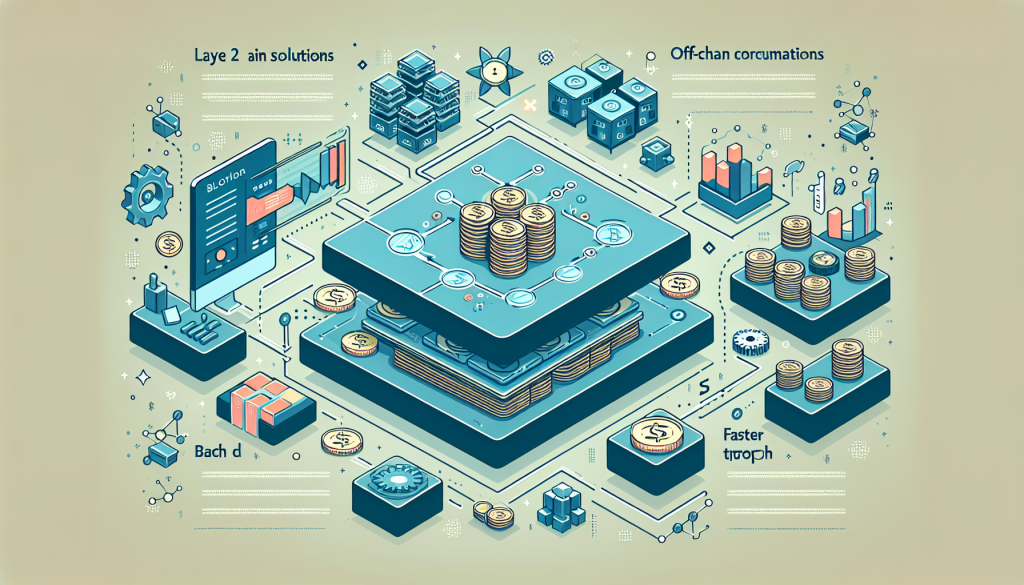
The blockchain industry continues to grapple with the fundamental challenge of scaling without compromising security or decentralization, leading to revolutionary developments in Layer 2 scaling solution architectures. These sophisticated systems have evolved far beyond simple transaction batching, now incorporating complex cryptographic proofs, advanced fraud detection mechanisms, and intricate economic incentive structures that maintain the security guarantees of their underlying Layer 1 networks.
At the core of every Layer 2 scaling solution lies a delicate balance between computational efficiency and cryptographic security. Optimistic rollups, for instance, operate under the assumption that transactions are valid by default, relying on a challenge period where validators can dispute fraudulent transactions. This approach requires sophisticated fraud proof systems that can efficiently verify the correctness of state transitions without requiring every network participant to execute every transaction. The infrastructure supporting these systems must handle massive amounts of data compression, state root calculations, and dispute resolution mechanisms while maintaining sub-second transaction finality for end users.
Zero-knowledge rollups represent the cutting edge of Layer 2 scaling solution technology, employing advanced cryptographic techniques to generate mathematical proofs of transaction validity without revealing the underlying transaction data. The infrastructure requirements for ZK-rollups are substantially more complex, requiring specialized hardware for proof generation, sophisticated circuit designs for different transaction types, and robust proof verification systems on the Layer 1 network. Recent advances in recursive proof systems and proof aggregation have enabled these solutions to process thousands of transactions while generating a single, compact proof that can be verified on-chain.
The security architecture of modern Layer 2 scaling solution implementations extends far beyond the cryptographic proofs themselves. Economic security models play a crucial role, with validator bonding mechanisms, slashing conditions, and reward structures carefully calibrated to ensure honest behavior. Many solutions implement multi-signature schemes for critical operations, requiring multiple independent parties to approve withdrawals or system upgrades. These security measures must account for various attack vectors, including validator collusion, eclipse attacks, and economic manipulation attempts.
Infrastructure resilience has become paramount as Layer 2 scaling solution networks handle billions of dollars in total value locked. Modern implementations feature redundant sequencer networks, automated failover mechanisms, and decentralized proof generation systems to eliminate single points of failure. The data availability layer represents another critical infrastructure component, with solutions ranging from on-chain data storage to specialized data availability committees and emerging data availability-focused blockchain networks.
Interoperability infrastructure has emerged as a defining characteristic of next-generation Layer 2 scaling solution architectures. Cross-rollup communication protocols enable seamless asset transfers and message passing between different Layer 2 networks without requiring users to return to the Layer 1 network. These systems implement sophisticated bridging mechanisms with their own security assumptions and trust models, often requiring additional validators and economic security measures to prevent cross-chain attacks.
The operational infrastructure supporting Layer 2 scaling solution networks involves complex orchestration of multiple components. Sequencer nodes must maintain high availability and low latency while processing thousands of transactions per second. Proof generation systems require specialized hardware and software optimizations to minimize proof generation time and costs. Monitoring and alerting systems must track network health, validator performance, and potential security threats across multiple interconnected systems.
Smart contract infrastructure on Layer 2 scaling solution networks has evolved to support increasingly complex applications while maintaining gas efficiency and security. Virtual machine implementations must provide full compatibility with existing smart contract code while optimizing for the unique characteristics of Layer 2 environments. State management systems must efficiently handle rapid state changes while providing the data needed for proof generation and dispute resolution.
As the Layer 2 scaling solution ecosystem continues to mature, the infrastructure and security requirements become increasingly sophisticated. The most successful implementations will be those that can seamlessly balance scalability, security, and decentralization while providing the robust infrastructure needed to support the next generation of blockchain applications. The evolution of these systems represents one of the most significant technical achievements in blockchain technology, demonstrating that the scalability trilemma can be addressed through careful engineering and innovative cryptographic techniques.